


Role of Ayurveda Services in Basic Health Services
 नेपाली हेल्थ २०८३ असोज १४ गते ७:०५ 0

Introduction:
Health is a fundamental necessity of human life. A prosperous nation cannot be envisioned without healthy citizens. The Constitution of Nepal 2072 (2015) guarantees every citizen the fundamental right to receive free basic health services.
To implement this constitutional provision, the Government of Nepal enacted the Public Health Service Act 2075 (2018), Basic Health Services 2075 (2018), and National Health Policy 2076 (2019). These policies and laws aim to provide citizens with accessible, affordable, quality, inclusive, and scientifically based health services.
Looking at the development of health services in Nepal, Ayurveda medicine has also been traditionally practiced alongside modern medicine. Ayurveda emphasizes healthy lifestyles, disease prevention, mental balance, and natural health promotion. Ayurveda has particular importance in Nepal’s social, cultural, and geographical context. Therefore, the Government of Nepal has incorporated Ayurveda into the national health system as a complementary and supportive health service.
However, according to modern evidence-based medicine, the effectiveness, safety, and quality of any treatment method need to be established through scientific research, clinical trials, and evidence-based practice. Therefore, the use of Ayurveda services should also be advanced in coordination with scientific studies, safety assessments, and evidence-based practices.
1. Concept of Basic Health Services 2075 (2018)
Basic Health Services 2075 is a health service package developed by the Government of Nepal to ensure citizens’ right to health. It aims to provide every citizen with essential health services free of charge.
It includes:
- Disease prevention
- Health promotion
- Treatment services
- Rehabilitation services
- Palliative services
The main objectives of these services are:
- To ensure equal access to health services for all citizens
- To extend health services to rural and remote areas
- To reduce economic inequalities in health services
- To strengthen primary health care
- To prioritize disease prevention and health promotion
Basic health services include maternal and child health, nutrition, immunization, mental health, control of communicable and non-communicable diseases, emergency services, and Ayurveda services.
2. Role of Ayurveda Services
2.1 Inclusion of Ayurveda Services
The National Health Policy 2076 (2019) and Basic Health Services 2075 (2018) have incorporated Ayurveda as a complementary health service within the health system. This provides citizens with the opportunity to receive health services through a pluralistic or multiple-system approach to healthcare.
The major objectives include:
- Expanding access to health services
- Preserving local medicinal plants and traditional knowledge
- Supporting health promotion and disease prevention
- Increasing health awareness in communities
Ayurveda services can play a supportive role, particularly in lifestyle management, health education, nutritional counseling, and chronic disease management.
2.2 Counseling and Treatment Services
The Ayurveda system places importance on maintaining balance among the body, mind, and lifestyle. Under basic health services, Ayurveda services include:
- Lifestyle counseling
- Dietary management
- Counseling on yoga and meditation
- Use of herbal medicines
- Supportive services for chronic disease management
Some studies have shown that yoga, meditation, healthy diets, and lifestyle improvements may help reduce the risk of non-communicable diseases such as mental stress, obesity, hypertension, and diabetes. However, modern scientific medicine is necessary for the treatment of serious diseases, emergencies, infections, surgical conditions, and complex illnesses.
Therefore, it is appropriate to use Ayurveda as a complementary health service.
2.3 Free Distribution of Ayurveda Medicines
The government has made arrangements to provide certain Ayurveda medicines free of charge under basic health services. This has particularly helped economically disadvantaged communities gain access to health services.
The objectives are:
- Expanding access to basic health services
- Utilizing local medicinal plants
- Providing healthcare options
- Reducing the financial burden
However, scientific evaluation of the quality, dosage, safety, and effectiveness of medicines is necessary.
3. Structure of Ayurveda Services
Nepal’s health service system is based on a pyramid structure.
(a) Local Level
- Health Posts
- Basic Health Centers
- Ayurveda Dispensaries
- Citizen Wellness Service Centers
(b) District and Provincial Levels
- Provincial Ayurveda Hospitals
- Ayurveda Hospitals
(c) Federal Level
- Central Ayurveda Hospital
- Research and Training Centers
The federal level plays a role in policy formulation, research, training, and human resource development.
4. Promotional Role of Ayurveda
Ayurveda gives priority to the principle of “Swasthasya Swasthya Rakshanam,” meaning the protection and preservation of the health of healthy individuals.
4.1 Lifestyle Management
Non-communicable diseases are increasing due to modern lifestyles. Ayurveda emphasizes:
- Regular daily routines
- Balanced diet
- Adequate sleep
- Physical activity
- Mental balance
These aspects are also consistent with modern public health and preventive medicine.
4.2 Yoga and Meditation
Yoga and meditation may help to:
- Reduce mental stress
- Improve physical flexibility
- Support mental health
The World Health Organization (WHO) and modern health research also recognize physical activity, stress management, and mental health promotion as important.
However, yoga and meditation are not alternatives to modern emergency treatment, surgery, antibiotics, or treatment of serious diseases.
4.3 Nutrition and Dietary Counseling
A balanced diet is the foundation of good health. Ayurveda emphasizes:
- Balanced meals
- Seasonal foods
- Natural food products
These principles are also consistent with modern nutritional science
5. Preventive Role
5.1 Disease Prevention
Ayurveda gives priority to preventing disease rather than treating it after it occurs.
Major approaches to disease prevention include:
- Healthy lifestyle
- Regular exercise
- Nutritious diet
- Protection of mental health
- Health awareness
These are consistent with the major principles of public health.
5.2 Contribution to Epidemics and Public Health
During the pandemic, infections, social distancing, prolonged confinement, reduced physical activity, psychological stress, and disruptions in healthcare services created significant challenges to both physical and mental health. In this context, greater attention was given to health-promoting practices such as maintaining a healthy lifestyle, consuming a balanced and nutritious diet, engaging in regular physical activity, practicing yoga and meditation, and maintaining psychological well-being.
Ayurveda’s holistic approach to health emphasizes appropriate diet, daily routines, physical activity, adequate rest, and mental well-being. These principles were considered relevant as supportive measures for maintaining general health and well-being during the pandemic. However, such practices should be understood as complementary health-promoting measures and not as substitutes for evidence-based measures for prevention, diagnosis, or treatment of infectious diseases.
- Coordination of Ayurveda with Modern Medical Services
An important feature of Basic Health Services 2075 is the development of a coordinated healthcare system between Ayurveda and modern medical services.
The benefits include:
- Expanded access to services
- Strengthened health education
- Multidimensional healthcare
- Support for disease prevention
However, when operating an integrated healthcare system, priority needs to be given to:
- Scientific research
- Safety testing of medicines
- Clinical evidence
- Studies of drug interactions
- Patient safety
7. Major Challenges
The major challenges include:
- Lack of skilled human resources
- Lack of research
- Quality management of medicines
- Lack of infrastructure
- Limited scientific evidence
In particular, according to modern evidence-based medicine, more extensive research is needed.
8. Prospects
As Nepal is a country rich in medicinal plants, there is considerable potential in the field of Ayurveda in areas such as:
- Research
- Health tourism
- Pharmaceutical production
- Yoga and meditation centers
- Conservation of medicinal plants
However, its development needs to be linked with scientific research, quality control, and evidence-based practice.
Conclusion
Basic Health Services 2075 (2018), National Health Policy 2076 (2019), the Public Health Service Act 2075 (2018), and the Constitution of Nepal 2072 (2015) have established health as a fundamental right of citizens. These policies aim to provide inclusive, accessible, and quality health services.
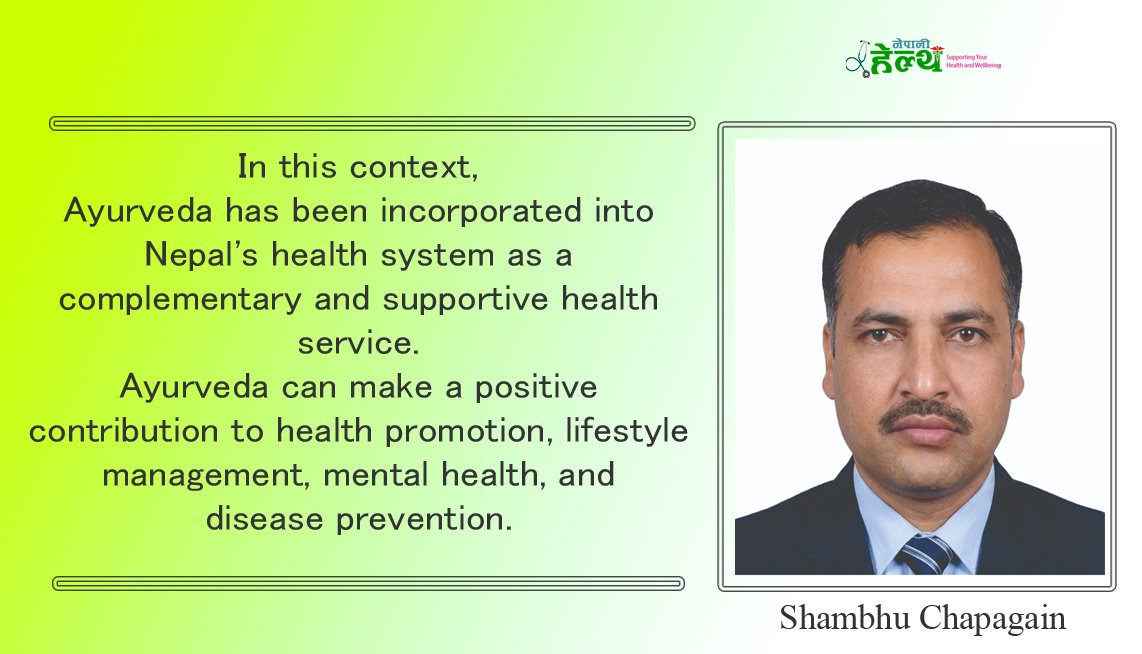
In this context, Ayurveda has been incorporated into Nepal’s health system as a complementary and supportive health service. Ayurveda can make a positive contribution to health promotion, lifestyle management, mental health, and disease prevention.
However, according to modern scientific medicine, the effectiveness and safety of any treatment method must be based on scientific evidence. Therefore, the development of Ayurveda services needs to move forward in coordination with research, clinical trials, and evidence-based practice.
In this way, if Ayurveda services are effectively developed in coordination with scientific approaches, public health principles, and national health policies, Nepal’s health system can become more inclusive, sustainable, and stronger.
#Mr. Chapagain, a Seventh-Level Kaviraj Officer, is currently serving at the Provincial Ayurveda Hospital in Tanahun.
विश्लेषण, सूचना, जानकारी तथा विज्ञापनका लागि हामीलाई (nepalihealthnews@gmail.com) मा सम्पर्क गर्नुहोला।


-
Role of Ayurveda Services in Basic Health Services
-
सदस्य नियुक्तिबारे भ्रामक प्रचार गरिएको भन्दै फार्मेसी परिषद्ले गर्यो खण्डन
-

यस्ता छन् आजको मन्त्रिपरिषद्को बैठकले गरेको छ वटा निर्णय
-

मधेशमा स्वास्थ्य शिक्षा र विशेषज्ञ सेवा विस्तार गर्न रामराजा प्रसाद सिंह प्रतिष्ठान आवश्यक : स्वास्थ्य मन्त्री मेहता
-

दिउँसो ३ बजे मन्त्रिपरिषद्को बैठक बस्दै
-
-

रामराजा प्रसाद सिंह स्वास्थ्य विज्ञान प्रतिष्ठान विधेयक, २०८३ संसदमा दर्ता
-
विभागलाई पठाएको टाइम फर्मास्युटिकल्सको पत्रमा उल्लेखित शब्दले चिडिए औषधी व्यवसायी
-

ट्रमा सेन्टरका स्वास्थ्यकर्मी र कर्मचारीद्धारा प्रधानमन्त्री दैवीप्रकोप कोषमा ४३ लाख ६० हजार ९ सय रूपैयाँ जम्मा
-

स्वास्थ्य सेवा विभागको नर्सिङ तथा सामाजिक सुरक्षा महाशाखाको निर्देशक परिवर्तन
-

नेशनल मेडिकल कलेजद्वारा आन्दोलनरत आवासीय चिकित्सकलाई १२ घण्टा भित्र क्वाटर छाड्न निर्देशन, आईओएम भन्छ-‘यस्तो गर्न मिल्दैन’
-