


A New Journey of Ayurveda: From Traditional Knowledge to Scientific Evidence



 Ayurveda is an ancient system of medicine. It has its own philosophy, approach to understanding disease, concepts of diet and lifestyle, medicines, and treatment methods. However, in today’s era of health science, an important question has emerged for Ayurveda: How can traditionally practice knowledge be transformed into modern scientific evidence?
This question is not only related to the future of Ayurveda. It is also connected with patient safety, medicine quality, effectiveness of healthcare services, and public health.
The World Health Organization (WHO) has also linked the integration of traditional, complementary and integrative medicine into health systems with scientific evidence, safety, quality, and regulation. The WHO Global Traditional Medicine Strategy for 2025-2034 has four major objectives: strengthening the evidence base, ensuring safety and regulation, appropriately integrating traditional medicine into health systems, and utilizing its cross-sectoral contributions.
The new journey of Ayurveda is therefore no longer merely a journey to preserve tradition; it is also a journey to validate traditional knowledge through scientific testing.
WHO’s New Message: Invest in Evidence Generation
On 16 September 2026, WHO published the “Global Research Priorities and Agenda for Traditional, Complementary and Integrative Medicine 2025-2034.” This latest development is important for the field of traditional medicine, including Ayurveda.
- Addressing the Lack of Research Funding
Although billions of people around the world use traditional and complementary medicine systems, less than 1% of global health research funding is reportedly invested in this field. The strategy aims to bring funders, researchers, and policymakers together and increase investment in evidence-based research.
- Key Research Priorities
The roadmap identifies the following priorities for the coming decade (2025-2034):
- High-priority health conditions: stroke, mental health, pain management, musculoskeletal conditions, cancer, and metabolic/endocrine health.
- Priority population and health-promotion areas: health promotion, healthy ageing, and child health.
- Cross-cutting issues: climate change and biodiversity, artificial intelligence (AI), pandemic preparedness, and antimicrobial resistance.
- Protection of Indigenous/Traditional Knowledge and Intellectual Property
- Emphasis is placed on the protection, autonomy, and benefit-sharing related to Indigenous and traditional medical knowledge.
- Since a significant proportion of modern medicines have links to natural products and traditional knowledge, attention is also given to protecting the rights and cultural integrity of Indigenous communities.
- Four Major Action Areas
- Translate: Transform research findings into policy and practice.
- Mobilize: Increase financial and technical resources.
- Implement: Strengthen evaluation methods and research infrastructure.
- Catalyze: Promote international collaboration and training.
This gives Ayurveda a clear message: research is becoming more important than promotion alone. It is no longer sufficient simply to claim that an Ayurvedic medicine or treatment is effective. It is necessary to scientifically demonstrate for which condition, in which patients, at what dose and for how long, and with what outcomes it produces results.
Research Priorities: Diseases, Populations, and Contemporary Issues
WHO’s new Research Agenda links important clinical conditions, populations, and cross-sectoral issues for public health and health systems with research priorities. It includes the need for research in areas such as stroke, mental health, pain management, musculoskeletal conditions, cancer, and metabolic/endocrine health. It also gives attention to health-promotion and population-related issues such as healthy ageing and child health, as well as cross-cutting issues including climate change, biodiversity, artificial intelligence, pandemic preparedness, and antimicrobial resistance.
When incorporating these subjects into Ayurveda, traditional concepts should not automatically be regarded as evidence for the treatment of modern diseases. Rather, the safety, effectiveness, implementation, and measurable health outcomes of Ayurvedic interventions need to be evaluated using appropriate modern research methodologies.
Respect for Traditional Knowledge, but Scientific Testing Too
The long tradition and accumulated experience of Ayurveda can be an important source for research. Medicinal plants, pharmaceutical combinations, diet and lifestyle practices, and treatment methods can help identify research questions and potential interventions. However, having been used for a long time and having scientifically proven effectiveness and safety are not the same thing.
Depending on the research question, methods such as preclinical studies, toxicology, pharmacology, clinical research, systematic reviews, and meta-analysis may be used. The research design should be selected according to the research question; it would not be scientifically appropriate to conclude that one method is sufficient for every Ayurvedic intervention.
CCRAS states that Ayurvedic clinical research may employ methods including observational studies, epidemiological assessments, pharmacovigilance and safety monitoring, exploratory/pilot trials, randomized controlled trials, pragmatic and real-world trials, systematic reviews, meta-analyses, evidence-gap mapping, and clinical guideline development.
Ayurvedic Medicines: Natural Does Not Automatically Mean Safe
The belief that “something is not harmful because it is natural” is not scientifically justified. Herbs and other natural substances may contain biologically active chemical compounds. Safety can be affected by dosage, identification, processing, manufacturing quality, contamination, interactions with other medicines, and an individual’s health condition.
Therefore, alongside evaluating the quality, safety, and effectiveness of Ayurvedic and herbal medicines, systematic monitoring of adverse events and adverse reactions is necessary. WHO’s TCIM strategy also emphasizes strengthening appropriate regulatory mechanisms and the evidence base for safe and effective traditional, complementary, and integrative medicine. This does not mean that Ayurvedic medicines are unsafe; rather, it means that quality control, appropriate regulation, clinical supervision, and pharmacovigilance are necessary for their safe and effective use.
Traditional Knowledge, Nature, and Intellectual Property
WHO’s strategy recognizes the importance of protecting Indigenous Peoples’ rights, culture, health, and traditional knowledge. Therefore, research based on medicinal plants or traditional knowledge should also consider the source of the knowledge, community rights, intellectual property, biodiversity, and benefit-sharing.
Nature and traditional knowledge have historically contributed to the development of modern medicines. However, instead of using a strong statement such as “40% of modern medicines are derived from traditional knowledge,” it is more appropriate to state, in evidence-based language, that nature and traditional knowledge have made important contributions to medicine development. WHO also recognizes the contribution of nature and traditional knowledge while emphasizing responsible use and conservation.
Ayurveda in Nepal: Institutional Foundations and the Need for Evidence
Nepal has government structures and programs for the institutional provision of Ayurveda services. The Department of Ayurveda and Alternative Medicine has published a list of 35 types of essential Ayurvedic medicines distributed free of charge by the Government of Nepal.
The operation of such services and programs is an important foundation. However, service access alone is not a sufficient indicator. Regular evaluation is necessary to determine how many people have benefited from programs such as Citizen Health Services and other Ayurvedic services, what changes have occurred in health outcomes, what the safety status of treatment has been, and how much health benefit has been achieved relative to cost.
Nepal can utilize its biodiversity and knowledge related to medicinal plants as an opportunity for research. If scientific identification, cultivation, conservation, quality control, standardization, pharmacological research, and clinical research can be connected into a single research chain, the value of Nepal’s medicinal resources can be enhanced within the country itself.
Panchakarma, Yoga, Diet, and Lifestyle: Areas for Evidence Generation
In Ayurveda, approaches related to health protection, diet and lifestyle, sleep, physical activity, and mental health are important. These can be studied in the context of preventive and promotive health.
However, measurable outcomes are necessary to establish whether a practice is effective. For example, changes in pain scores, blood pressure, sleep quality, quality of life, metabolic markers, or other clinically relevant outcomes can be evaluated using appropriate study designs.
Even when evidence regarding the effectiveness of Panchakarma, yoga, dietary management, or other Ayurvedic practices appears positive, the quality of the evidence, limitations of the studies, potential risks, and the patient’s condition should be considered before expanding such practices within healthcare services.
Ayurveda and Modern Medicine: Evidence-Based Collaboration Rather Than Competition
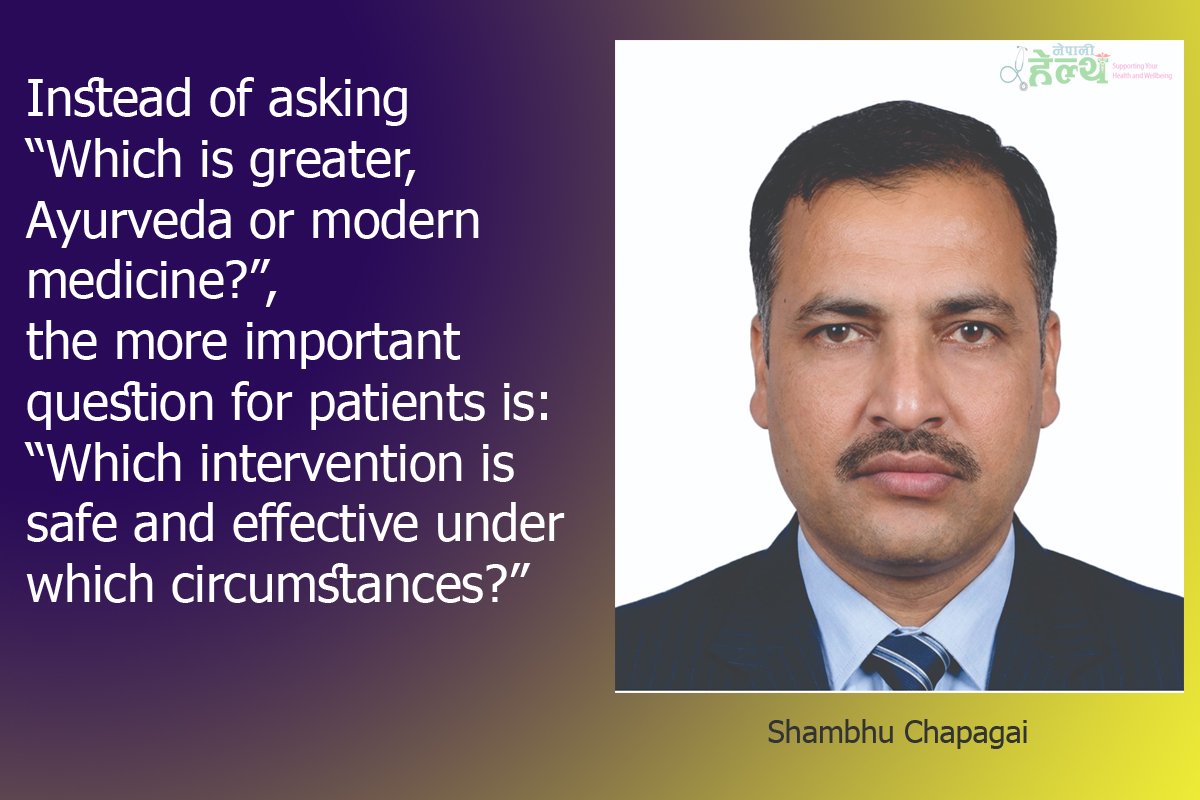
Instead of asking “Which is greater, Ayurveda or modern medicine?”, the more important question for patients is: “Which intervention is safe and effective under which circumstances?”
WHO’s strategy promotes the evidence-based, culturally respectful, and sustainable integration of TCIM into health systems. Therefore, the foundation for collaboration between Ayurveda and modern medicine should not be emotional support or rejection, but rather evidence, safety, quality, appropriate referral, clinical supervision, and patient welfare.
What Should Nepal Do Now ?
Nepal can prioritize the following areas to strengthen Ayurveda:
- Establish national Ayurvedic research policies and priorities.
- Develop a national database of Nepal’s medicinal plants.
- Expand standardization and quality-control laboratories for Ayurvedic medicines.
- Increase collaboration among universities, Ayurvedic hospitals, government research institutions, and international research organizations.
- Increase investment in randomized controlled trials, cohort studies, pharmacovigilance, and health-system research.
- Effectively regulate the quality of Ayurvedic medicines available in the market and the claims made in their advertising.
- Develop evidence grading systems and clinical guidelines for successful Ayurvedic treatments.
- Regularly evaluate the effectiveness and cost-effectiveness of Ayurvedic health services.
These priorities are also consistent with the directions emphasized by the WHO 2025-2034 strategy and the 2025–2034 Research Agenda regarding evidence generation, regulation, integration, and implementation.
Conclusion: The Future of Ayurveda Lies in Evidence
The strength of Ayurveda does not lie solely in its antiquity. Its future also depends on its ability to engage in dialogue with modern science, develop a research culture capable of testing its claims, and remain committed to placing patient safety at the center.
Traditional knowledge can be an important foundation for research, but it is not a substitute for evidence. When an intervention appears effective, the quality of the evidence should be presented. When evidence is weak, further research should be conducted. When safety risks are identified, they should be clearly communicated. Interventions supported by adequate evidence and appropriate regulation should be responsibly expanded within the health system.
WHO has given strategic priority to evidence generation, safety, regulation, and health-system integration in TCIM for the 2025-2034period. The new Research Agenda published on 16 September 2026 connects these priorities with concrete directions for research and investment.
For Nepal, this is an opportunity-to respect the traditions and knowledge of Ayurveda, institutionalize their scientific evaluation, strengthen the quality and safety of medicines and services, and responsibly utilize proven treatments within the health system. The new journey of Ayurveda can begin with the preservation of tradition and move forward toward scientific evidence, responsible regulation, and patient-centered healthcare.
Now is the time for Ayurveda not merely to tell the world about its ancient history, but also to present scientific evidence for its knowledge and practices.
#Mr. Chapagain, a Seventh-Level Kaviraj Officer, is currently serving at the Provincial Ayurveda Hospital in Tanahun.
विश्लेषण, सूचना, जानकारी तथा विज्ञापनका लागि हामीलाई (nepalihealthnews@gmail.com) मा सम्पर्क गर्नुहोला।


-

नेशनल मेडिकल कलेजमाथि प्रतिनिधि सभा बैठकमा लगाइएको आरोप छानविन गर्न निजी मेडिकल तथा डेन्टल एसोसिएसनको माग
-

नेपाल फार्मेसी परिषद्को सदस्यमा चार जना नियुक्त
-

बाल क्यान्सर उपचार सुधारका लागि राष्ट्रिय समन्वयमा जोड
-
नेपाल स्वास्थ्य व्यवसायी परिषद्ले लिएको १९ औँ नाम दर्ता परीक्षाको नतिजा सार्वजनिक, ४८ प्रतिशत उत्तीर्ण
-

बिरामी युवतीको गोप्य अंग छोएको आरोप लागेका स्वास्थ्यकर्मी थापा माथि करणी सम्वन्धी कसुरमा अनुसन्धान हुँदै
-