


Your Teeth Don’t Have to Hurt Before You Visit the Dentist



Every time I attend a family gathering, meet friends over tea or speak with people outside my clinic, someone eventually asks the same question.
“Doctor, my teeth don’t hurt. Do I still need to visit a dentist?”
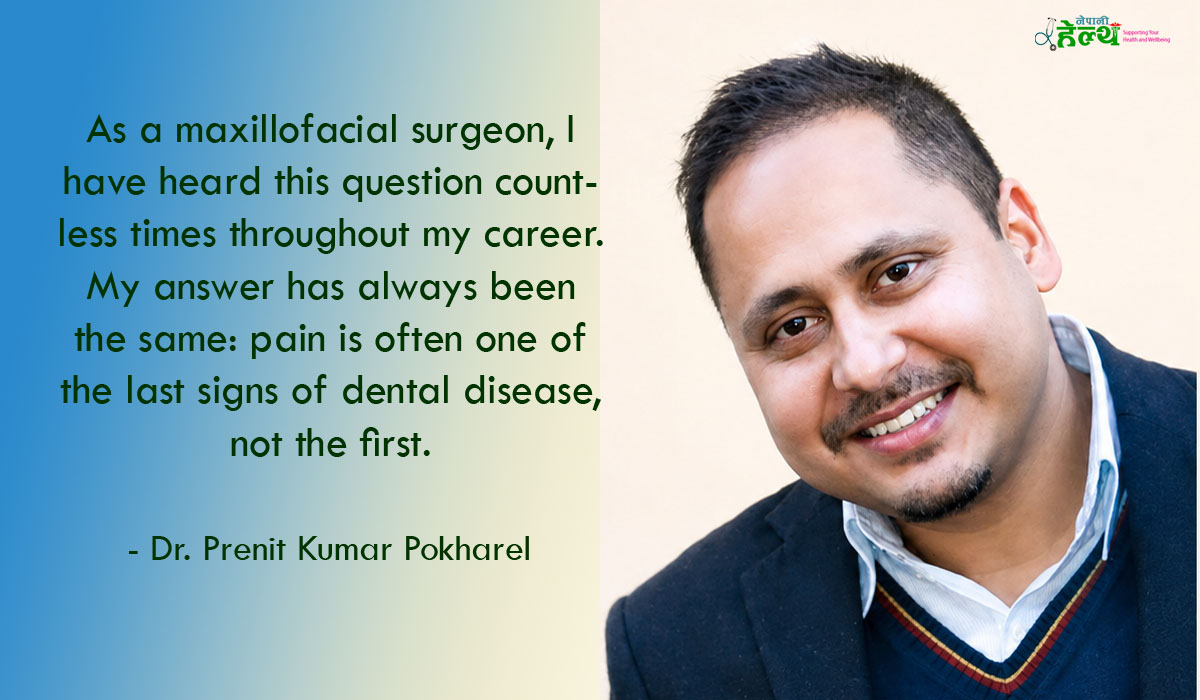
As a maxillofacial surgeon, I have heard this question countless times throughout my career. My answer has always been the same: pain is often one of the last signs of dental disease, not the first.
Unfortunately, many people believe that the absence of pain means the absence of disease. In reality, tooth decay, gum disease and several other oral conditions often progress silently. By the time a tooth begins to hurt, the disease may already have advanced to the point where treatment becomes more complicated, more expensive and, in some cases, irreversible.
This misconception is not unique to Nepal, but it is deeply rooted in our society. Many people visit a dental clinic only when they can no longer tolerate the pain. Others postpone treatment because they fear dental procedures, worry about the cost or simply believe that brushing their teeth is enough to keep their mouths healthy. These beliefs, although understandable, often lead to unnecessary suffering.
As clinicians, we frequently see problems that could have been prevented. A small cavity that could have been treated with a simple filling may eventually require root canal treatment or extraction. Early gum disease, which can often be controlled with professional cleaning and improved oral hygiene, may progress to tooth loss if left untreated. Even certain lesions inside the mouth, which patients often ignore because they are painless, deserve timely professional evaluation. In many situations, early diagnosis makes treatment simpler and the outcome better.
Preventive dentistry is based on a simple principle: it is always easier to prevent disease than to treat its consequences.
We readily understand this concept in other areas of health. We monitor our blood pressure before it causes a stroke. We vaccinate our children before they become ill. We undergo health screening to detect disease early. Yet when it comes to oral health, many of us still wait until pain forces us into the dental chair.
This approach needs to change
Oral health is far more important than many people realise. A healthy mouth allows us to eat comfortably, speak clearly, smile confidently and interact socially without embarrassment. Poor oral health affects nutrition, communication, school performance, productivity and overall quality of life. It influences not only our physical wellbeing but also our psychological and social health.
Research from different parts of the world has consistently shown that people who attend routine dental check-ups generally report better oral health, retain more of their natural teeth and experience a better quality of life than those who seek dental care only when problems arise. Studies have also demonstrated that irregular dental visitors are more likely to lose teeth than individuals who receive regular preventive care. These findings reinforce a simple but powerful message: routine dental visits help preserve oral health rather than merely treat disease.
Regular dental examinations also allow dentists to detect problems that patients may not notice themselves. Small cavities hidden between teeth, early gum disease, defective fillings, abnormal oral lesions and other conditions are often discovered during routine examinations before they produce symptoms. Early intervention usually requires less extensive treatment and reduces both financial cost and physical discomfort.
In recent years, social media has become an important source of health information. While it has undoubtedly increased public awareness about oral health, it has also created confusion. Short videos, promotional content and unverified advice frequently circulate online, making it difficult for people to distinguish evidence from opinion. As health professionals, we encourage everyone to seek information from reliable sources and to consult qualified dental practitioners rather than relying solely on online influencers. Good decisions about health should always be guided by sound scientific evidence.
Ultimately, a routine dental check-up is not about finding problems; it is about preventing them. The goal is not simply to repair damaged teeth but to preserve healthy ones for as long as possible.
Yet despite the well-established benefits of preventive dental care, many people continue to postpone visiting a dentist. The reasons are understandable. Some fear that every dental visit will be painful. Others worry about the cost of treatment, while many simply believe there is no need to see a dentist unless something hurts. In some communities, access to dental services remains limited, making regular check-ups even less common.
These barriers deserve attention, but they should not discourage us from seeking preventive care. In fact, postponing a routine examination often leads to more extensive treatment later. A problem that could have been managed with a simple filling may eventually require root canal treatment, surgery or even the loss of a tooth. Delaying care rarely reduces the cost of treatment; more often, it increases both the financial burden and the physical discomfort.
Routine dental visits are about far more than detecting cavities. During a comprehensive examination, dentists assess the health of the gums, evaluate existing restorations, examine the oral tissues for abnormalities and identify early signs of conditions that patients themselves may never notice. Advice on oral hygiene, dietary habits, tobacco cessation and preventive measures also forms an important part of every consultation. In this sense, a dental visit is not simply treatment—it is education.
Modern research has also strengthened our understanding of the relationship between oral health and general health. Healthy gums contribute to overall well-being, while untreated oral diseases may complicate the management of certain systemic conditions. Although the mouth is only one part of the body, it should never be considered separately from general health. Looking after our oral health is an essential component of looking after ourselves.
As a maxillofacial surgeon, I have often treated patients whose conditions might have been managed more simply had they sought professional care earlier. This is not a criticism of patients; it is a reminder that awareness remains one of our greatest challenges. Most people do not delay treatment because they are careless. They delay because they do not recognise the early warning signs or because they underestimate the importance of routine examinations.
This is where public health has an important role to play. Schools, community organisations, professional associations, healthcare institutions and the government all share a responsibility to promote preventive oral health. Children should grow up understanding that visiting a dentist is no different from receiving routine medical check-ups or vaccinations. Preventive dental care should become a normal family habit rather than an emergency response to pain.
Dentists, too, have a responsibility beyond treating disease. Every patient encounter is an opportunity to educate, motivate and build trust. A reassuring conversation can often reduce fear more effectively than any instrument or medication. When patients understand why preventive care matters, they are more likely to return before problems become severe.
Changing long-established attitudes will not happen overnight. However, every parent who schedules a child’s routine dental visit, every adult who chooses a preventive examination instead of waiting for pain, and every healthcare professional who encourages healthy oral habits contributes to a healthier society.
The message is simple, but it carries lifelong importance
We service our vehicles before they break down. We monitor our blood pressure before complications develop. We vaccinate our children to prevent disease rather than wait for illness to appear. Our teeth deserve the same preventive attention.
A routine dental check-up may take less than an hour, but its benefits can last for years. It can preserve natural teeth, prevent unnecessary pain, reduce treatment costs, improve confidence and contribute to a better quality of life. More importantly, it reminds us that good health is built not only by treating disease but by preventing it.
A few years ago, a middle-aged gentleman was brought to my clinic by his son because of a non-healing ulcer inside his mouth. The ulcer had been present for several months. Like many people, he assumed it was a minor sore caused by a sharp tooth and believed it would heal on its own. Because it was not causing severe pain initially, he never felt the need to consult a dentist.
It was only after he visited a physician for an unrelated health concern that the ulcer was noticed. Recognizing that something was not right, the physician referred him to me for further evaluation.
When I asked the gentleman why he had waited so long, his answer was simple and heartbreaking: “I thought it would heal by itself.”
After a thorough examination, I performed a biopsy. The diagnosis confirmed a well-differentiated squamous cell carcinoma. During the examination, I also noted fibrotic changes in the oral tissues that suggested a longstanding underlying condition requiring attention.
As clinicians, we cannot say with certainty what the outcome would have been had he sought care earlier. But we do know that persistent oral ulcers and other suspicious lesions should never be ignored. Earlier assessment might have allowed earlier diagnosis and intervention, potentially improving treatment options and outcomes.
I often think about that patient. His story reminds me that the greatest challenge in oral health is not always the disease itself—it is the delay in seeking professional advice. That is why I encourage everyone to take persistent changes in the mouth seriously. If an ulcer, swelling or patch does not heal within two weeks, it deserves examination by a qualified dental professional.
The next time you find yourself asking, “My teeth don’t hurt—do I really need to see a dentist?” I hope you will remember one simple truth:
Your teeth don’t have to hurt before you visit the dentist. They simply deserve your care.
# Dr. Pokharel is a Maxillofacial Surgeon, former Dean of Karnali Academy of Health Sciences
विश्लेषण, सूचना, जानकारी तथा विज्ञापनका लागि हामीलाई (nepalihealthnews@gmail.com) मा सम्पर्क गर्नुहोला।



-

रामराजा प्रसाद सिंह स्वास्थ्य विज्ञान प्रतिष्ठान विधेयक, २०८३ संसदमा दर्ता
-

त्रिवि शिक्षण अस्पतालले सञ्चालनमा ल्यायो नेपालकै पहिलो ‘पुरुष स्वास्थ्य क्लिनिक’
-

विभागलाई पठाएको टाइम फर्मास्युटिकल्सको पत्रमा उल्लेखित शब्दले चिडिए औषधी व्यवसायी
-

स्वास्थ्य व्यवस्थापन सूचना प्रणाली: ऐतिहासिक पृष्ठभूमि, वर्तमान परिदृश्य र आगामी दिशा
-

स्वास्थ्य सेवा विभागको नर्सिङ तथा सामाजिक सुरक्षा महाशाखाको निर्देशक परिवर्तन
-